Key Takeaways
- AI in embedded systems enables devices to analyse data and make decisions locally.
- Applications include healthcare wearables, automotive systems, manufacturing, smart homes and agriculture.
- Benefits include faster responses, reduced data transmission and potential privacy improvements.
- Memory, processing power, battery life, security and model accuracy remain key challenges.
- Practical embedded development skills help engineers build and optimise reliable AI-enabled devices.
- Explore Maven Silicon’s Advanced Embedded System Design Course to strengthen your technical foundations.
Introduction
What if your smartwatch could recognise an unusual pattern, or a factory sensor could flag a machine fault before production stopped? These are practical examples of AI in embedded systems, where devices combine computing with intelligence to make decisions closer to where data is generated.
As connected devices become more capable, engineers are finding new ways to integrate machine learning into compact, power-efficient hardware. But how does this work, where is it useful and what challenges should developers expect? Let us explore.
What Are AI-Powered Embedded Systems?
An embedded system is a computer built into a larger device to perform specific functions. Adding artificial intelligence allows it to analyse inputs, recognise patterns and make predictions instead of relying entirely on predefined rules.
Traditional systems might trigger an alarm when a sensor crosses a fixed threshold. With embedded systems machine learning, a device can analyse patterns in sensor readings to identify unusual behaviour that fixed rules might miss.
This approach combines hardware, firmware, sensors and trained models. It is an important development in embedded system technology, particularly when devices need to respond quickly without depending on constant cloud connectivity.
Where Are AI-Powered Embedded Systems Used?
From everyday electronics to the industrial equipment, machine learning for embedded systems supports applications where local analysis improves responsiveness and automation.
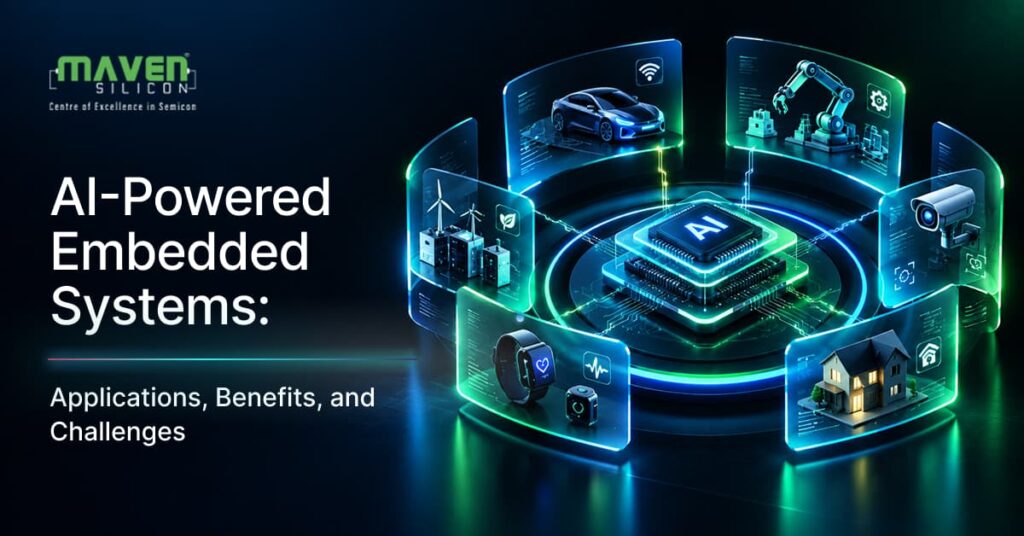
- Healthcare: Wearables can analyse sensor readings to identify patterns that may warrant attention.
- Automotive: Driver-monitoring systems can recognise signs of distraction, while advanced driver-assistance systems analyse sensor inputs.
- Manufacturing: Equipment can detect unusual operating patterns and help maintenance teams investigate potential faults.
- Smart homes: Devices can recognise voice commands, detect activity and adjust settings based on observed patterns.
- Agriculture: Smart sensors can analyse environmental readings to support irrigation decisions and crop monitoring.
These applications show how machine learning and applications are becoming increasingly connected to real-world engineering needs.
What Are the Real Benefits?
- Faster responses: Local processing can reduce network-related delays.
- Lower connectivity requirements: Devices may continue performing the supported inference tasks even without a continuous internet connection.
- Improved privacy: Sensitive data can remain on the device when local processing is appropriately designed.
- Reduced data transmission: Sending selected results, rather than just continuous raw data, reduces network usage.
- Predictive maintenance: Analysing operating patterns can help identify potential faults earlier.
- Greater autonomy: Devices can perform certain intelligent tasks without waiting for a remote service.
According to Grand View Research , the global embedded AI market was valued at roughly USD 9.97 billion in 2024 and is expected to reach about USD 21.93 billion by 2030. That’s not a niche trend; that’s an industry-wide shift in how devices are designed.
What Challenges Should Engineers Prepare For?
- Limited memory and processing power: Large models may not fit or run efficiently on small devices.
- Power consumption: More computation can reduce battery life and further increase heat.
- Accuracy and reliability: Poor quality data or changing operating conditions can strongly affect predictions.
- Security: Devices and their models need effective protection against unauthorised access and tampering.
- Hardware compatibility: Different processors, toolchains and accelerators can complicate deployment or cause unwanted delays.
- Testing complexity: Developers must validate performance under realistic conditions and not just in a controlled environment.
A successful embedded system design therefore balances intelligence with practical constraints.
How Can Developers Overcome These Challenges?
Start with the application rather than the model. Define the required response time, acceptable error rate, power budget and available memory before choosing a solution.
- Select a model suited to the task and target hardware.
- Use quantisation or other optimisation techniques where appropriate.
- Measure memory use, latency and energy consumption on the actual device.
- Test with representative data, including unusual and challenging conditions.
- Build security and update mechanisms into the design.
- Monitor performance after deployment and plan for maintenance
Developers should also understand how firmware, operating systems, peripherals and hardware interfaces work together. These fundamentals make it easier to integrate machine learning without compromising the reliability expected from embedded products.
Why Build Your Embedded Systems Skills with Maven Silicon?
Working with machine learning AI-enabled devices requires more than theoretical knowledge. Engineers need to understand how software interacts with hardware and how to turn concepts into functioning systems.
Maven Silicon’s Advanced Embedded System Design Course uses a project-based learning approach, with a strong practical component. Its published curriculum covers Embedded C, Linux system programming, IoT, peripheral interfaces and an introduction to machine learning, supported by labs and projects.
This foundation can help learners understand the engineering principles behind intelligent devices and build practical embedded development skills. If you want to strengthen your understanding of embedded development, contact the team to discuss the programme.