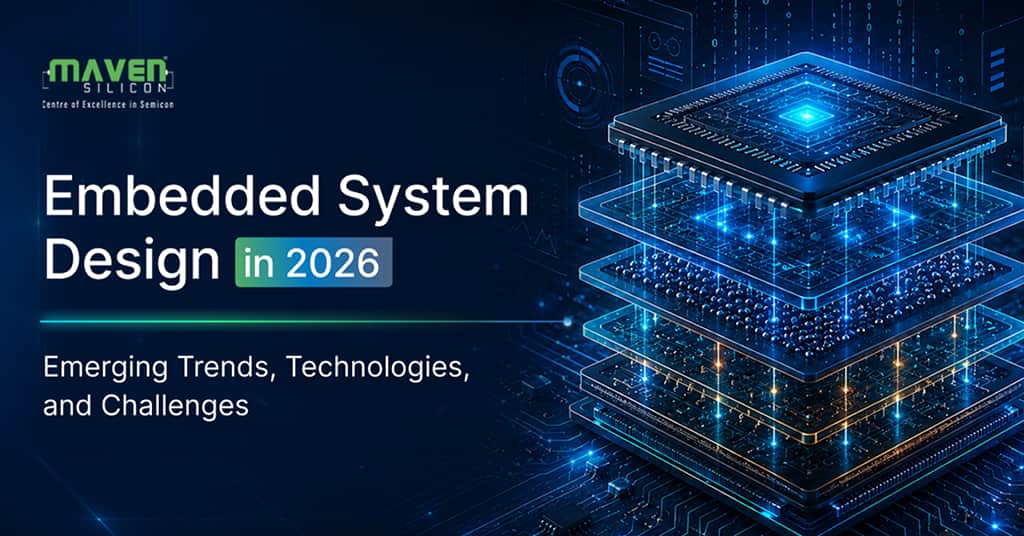

Look around you right now. The fitness band on your wrist, the car in your garage, and the smart thermostat on your wall are all quietly run by embedded systems. In 2026, this once niche discipline sits at the centre of nearly every innovation, from autonomous vehicles to smart factories. For final year students and working professionals alike, knowing where embedded system design is headed matters. This blog covers the evolution, trends, tools, and career paths that define embedded systems in 2026, and how an Embedded Systems Course can help you get there faster.
How Has Embedded System Design Evolved from the Past to 2026?
Embedded system design has come a long way from single purpose microcontrollers running a handful of instructions. In the 1980s and 90s, embedded systems powered narrow tasks, calculators, washing machines, pagers, on 8 bit processors with a few kilobytes of memory. The 2000s brought networked devices and real time operating systems. The 2010s pushed design towards connectivity, cloud integration, and security.
Today, in 2026, embedded system design looks entirely different:
- Multi core System on Chip platforms replace single microcontrollers
- Artificial intelligence runs directly on the device instead of the cloud
- Open-source architectures such as RISC-V challenge decades of proprietary dominance
- Security is built into hardware from day one, not added later
This evolution reflects a simple truth: embedded engineers today must think like software architects, hardware designers, and security experts, all at once
What Are the Emerging Trends Shaping Embedded Systems in 2026?
Keeping pace with emerging trends in technology has become a core skill for every embedded engineer. Here are five shifts defining embedded systems this year:
- AI and Machine Learning at the Edge (TinyML and Edge AI)
Running machine learning models directly on microcontrollers, rather than the cloud, is no longer experimental. TinyML lets sensors detect anomalies or predict failures without an internet connection. The global edge AI market is set to grow from roughly USD 24.9 billion in 2025 to about USD 118.7 billion by 2033, favouring devices with faster response times and lower running costs. - RISC-V Architecture: The Open Source Hardware Revolution
RISC-V has moved from an academic curiosity to a genuine challenger against ARM and x86. Its open instruction set lets chipmakers design custom, royalty free processors for specific workloads. Recent forecasts suggest RISC-V based chip shipments could reach roughly 35.9 billion units by 2031. Engineers who understand this architecture are sought after, something Maven Silicon’s RISC-V training programmes prepare learners for directly. - Hyperconnected IoT: Embedded Systems in a 5G World
With 5G rolling out across industries, embedded devices must communicate faster and more reliably than before. Ultra low latency networks enable real time control in factories, remote healthcare, and autonomous vehicles, turning connectivity into a core design constraint rather than an afterthought. - Energy Harvesting and Ultra Low Power Design
Battery life remains the biggest constraint for wearables and remote monitoring devices. Energy harvesting techniques, solar, vibration, and thermal, are combined with ultra low power microcontrollers to keep devices running for years without a battery change, supporting sustainable IoT deployments across agriculture, healthcare, and industrial monitoring. - Chiplet Based Embedded Design
Instead of one large monolithic chip, designers now combine smaller specialised chiplets for memory, processing, and connectivity into a single package. This modular approach cuts development cost, improves manufacturing yield, and lets embedded systems mix and match components suited to a specific product.
Which Key Technologies Are Driving Embedded Systems in 2026?
Beyond broad trends, specific technologies are reshaping how embedded technology gets built and deployed. Four stand out this year:
- Advanced SoC and Heterogeneous Computing
Modern embedded platforms combine CPUs, GPUs, and dedicated AI accelerators on a single System on Chip. This lets one device handle sensor fusion, image processing, and control logic simultaneously, and is now standard across automotive, robotics, and industrial automation. - Neuromorphic Computing in Embedded Devices
Inspired by the human brain, neuromorphic chips process information using spiking neural networks rather than traditional logic gates. They consume a fraction of the power needed for conventional AI processing, making them well suited to always on sensors in hearing aids, security cameras, and industrial monitoring. - Embedded Security: Zero Trust Hardware Design
With billions of connected devices in the field, security can no longer be an afterthought. Zero trust hardware design assumes no component, however small, can be blindly trusted. Secure boot and hardware root of trust are becoming default requirements in embedded product development. - Digital Twin Integration for Embedded Testing
Digital twins, virtual replicas of physical embedded systems, let engineers test firmware and validate performance before hardware even exists. This shortens development cycles and reduces late stage bugs, especially in complex systems like electric vehicles. Learners exploring an embedded programming course increasingly practise on such simulated environments first.
What Are the Top Tools and Frameworks for Embedded Developers in 2026?
Choosing the right toolchain can make or break a project. In 2026, embedded developers commonly work with:
- Zephyr RTOS and FreeRTOS for real time scheduling
- PlatformIO and Keil for cross platform firmware development
- TensorFlow Lite for Microcontrollers and Edge Impulse for on device inference
- Renode and QEMU for hardware simulation
- Rust alongside modern C toolchains for safer, faster firmware
Frameworks built for embedded machine learning let engineers train a model on a laptop and shrink it to run on a chip with kilobytes of memory. Mastering these tools alongside a strong foundation from an embedded C programming course gives graduates a genuine edge in interviews.
What Challenges Do Engineers Face in Embedded System Design in 2026?
- Balancing AI performance with power budgets measured in milliwatts
- Managing a fragmented RISC-V and ARM toolchain ecosystem
- Meeting stricter cybersecurity regulations across regions
- Debugging increasingly complex, multi core, heterogeneous systems
- Shortening development cycles while maintaining safety certifications in automotive and medical devices
A talent shortage compounds all of this. Engineers need to be fluent in hardware, firmware, cloud integration, and increasingly machine learning, a combination few university curricula fully prepare graduates for.
Which Career Opportunities and Skills Await Embedded Engineers in 2026?
Demand for skilled embedded engineers keeps climbing across semiconductor, automotive, healthcare, and industrial sectors. Here is a snapshot of roles open to graduates and professionals in 2026:
| Job Role | Key Skills | Industries |
|---|---|---|
| Embedded Software Engineer | Embedded C, RTOS | Automotive, Electronics |
| Embedded Systems Developer | Microcontrollers, peripherals | Semiconductor, Industrial |
| IoT Developer | Cloud, sensors, protocols | Smart Home, Healthcare |
| Embedded Firmware Engineer | Bare metal C, bootloaders | Aerospace, Telecom |
| Embedded Linux Developer | Device drivers, BSP | Networking, Automation |
| Embedded Security Engineer | Secure boot, cryptography | Automotive, Fintech |
| Silicon Validation Engineer | SoC testing | Semiconductor |
| Embedded Test Engineer | Test automation | Medical Devices |
| Control Systems Engineer | Sensors, actuators | Robotics |
| Data Acquisition Engineer | Signal processing | Instrumentation |
A structured internship, such as Maven Silicon’s Embedded Systems Internship, often bridges the gap between classroom learning and these job roles.
Where Should You Begin Your Embedded Journey?
Embedded system design in 2026 sits at the crossroads of hardware, software, and artificial intelligence, and it shows no sign of slowing down. Whether you are a student preparing for your first job, a professional pivoting into VLSI and embedded design, or an organisation seeking to upskill engineering teams, the opportunity window is wide open.
Maven Silicon’s Advanced Embedded System Design Course is built for this moment, and our Corporate Training programmes help organisations build in house embedded talent at scale. Start where you are, the industry is waiting.
Reference link :
https://www.grandviewresearch.com/industry-analysis/edge-ai-market-report
https://riscv.org/blog/shd-forecast-2026